
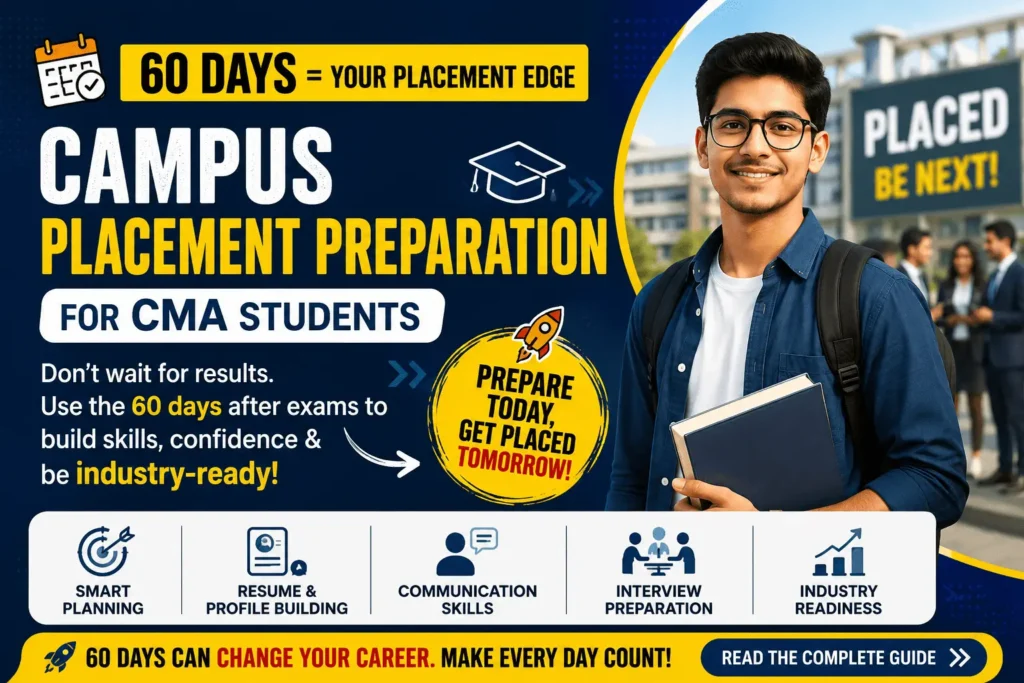
How to Prepare for CMA Campus Placement in 2026
Campus Placement Preparation for CMA Students: How to Use the 60 Days After Exams Effectively
“The biggest mistake students make after exams is assuming that placement preparation starts after the result is declared.”
In reality, by the time the result arrives, many companies have already started identifying candidates who appear confident, prepared, and industry-ready.
The period between your CMA examinations and campus placements is not a waiting period.
It is a preparation period.
Think about it.
For months, you have invested your time in clearing examinations. Now, for the next 60 days, your focus should shift from becoming exam-ready to becoming industry-ready.
The students who utilise these weeks wisely often enter placement season with confidence.
The students who don’t usually spend the same period battling anxiety, uncertainty, and last-minute preparation.
So, how should a CMA student use these crucial 60 days?
Let’s build a practical roadmap.
Phase 1: Recover, Reflect and Reconnect (Week 1)
The first few days after examinations are important.
Take a break.
Spend time with family.
Catch up on sleep.
Recharge mentally.
But don’t allow a 5-day break to become a 5-week break.
Use this time to reflect:
- What are your strengths?
- What type of role interests you?
- Finance?
- Costing?
- Internal Audit?
- Taxation?
- FP&A?
- Business Finance?
Before preparing for companies, understand the direction you want to pursue.
Phase 2: Know Yourself Before Selling Yourself (Week 2)
Most students start preparing resumes immediately.
A better starting point is understanding yourself.
A professional Personality Assessment can help identify:
- Natural strengths
- Communication style
- Leadership tendencies
- Decision-making approach
- Team behaviour
- Development areas
Why is this important?
Because recruiters are not hiring marks.
They are hiring people.
When an interviewer asks:
“Tell me about yourself.”
“What are your strengths?”
“Why should we hire you?”
Your answers become more authentic when they are based on self-awareness rather than memorized responses.
The earlier you understand yourself, the stronger your interview performance becomes.
Phase 3: Build Your Professional Brand (Week 2-3)
Today, recruiters often see your digital profile before meeting you personally.
This is the right time to:
Update Your Resume
Focus on:
- Educational qualifications
- CMA status
- Articleship or internship exposure
- Projects
- Certifications
- Software skills
- Achievements
Optimise Your LinkedIn Profile
Your LinkedIn profile should clearly communicate:
- Who you are
- What you have done
- What you aspire to do
A strong LinkedIn presence can significantly improve your professional visibility.
Phase 4: Refresh Technical Concepts (Week 3-6)
One common misconception is that students should start studying all subjects again.
That is neither practical nor necessary.
Instead, focus on concept brushing.
Recruiters are rarely interested in testing your memory.
They are interested in understanding whether your concepts are clear.
Prepare concise revision notes for:
- Cost and Management Accounting
- Strategic Financial Management
- Direct Taxation
- GST and Customs
- Corporate Laws
- Financial Accounting
- Budgeting and Performance Management
Focus on:
- Practical applications
- Industry examples
- Recent developments
- Frequently asked interview questions
The objective is clarity, not cramming.
Phase 5: Develop Communication Skills (Week 3-8)
Many technically strong students lose opportunities because they struggle to express themselves.
Communication is one of the most underrated placement skills.
Practice daily:
- Self-introduction
- Extempore speaking
- Business news discussion
- Presentation skills
- Professional conversations
Even 20 minutes per day can create remarkable improvement over two months.
Phase 6: Master Group Discussions (Week 4-8)
Most students prepare for interviews.
Very few prepare for Group Discussions.
This is a mistake.
A GD is often the first stage of elimination.
Learn how to:
- Start a discussion
- Build upon others’ ideas
- Present structured viewpoints
- Handle disagreement professionally
- Summarize discussions effectively
Participate in mock GDs on topics such as:
- Artificial Intelligence
- ESG Reporting
- Union Budget
- Inflation
- Digital Economy
- Future of Finance Professionals
Remember:
A good GD participant is not the person who speaks the most.
It is the person who adds the most value.
Phase 7: Mock Interviews – The Game Changer (Week 5-8)
No amount of reading can replace actual interview practice.
Mock Interviews help identify:
- Weak answers
- Confidence issues
- Communication gaps
- Body language concerns
- Technical blind spots
Prepare for questions like:
- Tell me about yourself.
- Why CMA?
- Why should we hire you?
- What are your strengths and weaknesses?
- Explain a recent financial news event.
- Where do you see yourself after five years?
Every mock interview reduces anxiety and improves confidence.
Phase 8: Build Business Awareness (Throughout the 60 Days)
Recruiters increasingly look for commercially aware candidates.
Make it a habit to spend 15 minutes daily reading:
- Economic Times
- Business Standard
- Mint
- Financial Express
Track:
- GDP growth
- Inflation
- RBI policies
- GST developments
- Corporate mergers
- Industry trends
A candidate who understands business earns instant credibility.
The 60-Day Formula for Placement Success
Most students believe placement success depends on academic knowledge.
Academic knowledge is only one part of the equation.
A successful placement candidate combines:
- Technical Knowledge
- Self-Awareness
- Communication Skills
- Business Awareness
- Interview Readiness
- Professional Presence
This combination creates confidence.
And confidence creates opportunities.
Final Thoughts
The period between examinations and campus placements is one of the most valuable investments you can make in your professional career.
Do not treat these 60 days as waiting time.
Treat them as preparation time.
Because when campus placements begin, you don’t want to be preparing.
You want to be ready.
At Dhruv Coaching Classes, we encourage students to start early through Personality Assessments, Career Clarity Sessions, Resume Building, LinkedIn Optimisation, Group Discussion Practice, Mock Interviews, and Placement Readiness Programmes.
Because successful placements are not achieved by chance.
They are achieved through preparation.
Start Early. Know Yourself. Build Confidence. Stay Stress-Free.

By Profession She is a Chartered Accountant and by Passion an Education Entrepreneur and a Performance and Transformation Coach. Presently working as a dynamic leader of Dhruv Coaching Classes, with over 18 years of diversified experience with Vedanta Group , as an Educator specializing in Indirect Taxation and Corporate Law , GST Consultant . An ACC-certified coach (ICF-USA) and Certified Career Counsellor from UCLA, she blends her expertise in professional education with a passion for mentoring of Young Adults and Women’s empowerment . Her involvement with organizations like the Cherie Blair Foundation (USA) as a business coach and Speaker at ICAI and ICSI highlights her dedication to mentoring and Coaching . Furthermore, her strategic vision in EdTech and the development of ‘Beyond Academics’ life-skills modules showcase her holistic approach to student development .